Chemical Policies
Public policies can help or hinder the advancement of green chemistry. Get involved with our resources on the critical connection between green chemistry and policy. Use the search form at the bottom of this page to find example policies related to chemicals management and sustainability.
Public Policy
Public policy refers to the actions and decisions made by governments to address societal and global issues. These include but are not limited to the creation of laws, regulations, programs, and initiatives. It also includes the budget process, where resources are allocated to implementation of laws and programs, including research. Public policy influences the funding, direction and priorities of the scientific research community.
For researchers, understanding public policy is important because it shapes the funding landscape, sets regulatory frameworks, and defines societal challenges that science is expected to help solve. Policy decisions can determine which research areas receive attention and resources, and they often require scientific evidence and expertise to be effective.
Public policy is not static. It evolves through political processes, stakeholder engagement and evidence-based inputs. Scientists can contribute to policy by providing data, advising decision-makers, participating in public consultations or helping translate complex research findings into accessible information for policymakers.
Four policy examples are:
- The National Science Foundation Act of 1950 (PDF) which established the United States (US) National Science Foundation (NSF) to promote basic research and education in the sciences
- The European Union REACH Regulation (EC 1907/2006) which governs the registration, evaluation, authorization, and restriction of chemicals to protect human health and the environment from harmful substances
- India’s National Action Plan on Climate Change (PDF) which outlines a national strategy with eight missions address climate change while supporting economic growth and development.
- The Stockholm Convention is an international treaty that aims to protect human health and the environment from persistent organic pollutants by eliminating the production, use and trade of the persistent organic pollutants listed, disposing of stockpiles and wastes safely and promoting best practices and safer alternatives.
How are Green Chemistry and Public Policy Connected?
In the context of green chemistry, governmental policies can:
- Establish initiatives to create, recognize or enlarge markets for green and sustainable chemistry products and processes (such as certification programs like Safer Choice, award programs like the EPA Green Chemistry Awards and UNIDO ONE World Sustainability Awards, grant programs like the Small Business Innovation Research (SBIR) program and the Washington State Industrial Symbiosis Grant Program, procurement directives and tax incentives).
- Require transparency of information to the public. This can help us to better understand where there are opportunities for green chemistry innovation (For example, the California Cleaning Product Right to Know Act ).
- Support the development and implementation of government research or innovation efforts like the U.S. Federal Sustainable Chemistry Strategic Plan (PDF), required by the Sustainable Chemistry Research and Development Act and the Safe and Sustainable by Design initiative within the European Green Deal.
- Set milestones or limits for the reduction of prioritized substances of concern (such as the European Commission working document Restrictions Roadmap). These efforts provide opportunities for scientists in academia, industry, and government to establish prioritization processes, to develop safer alternatives and to improve product designs (such as the Stockholm Convention on Persistent Organic Pollutants).
- Convene working groups to develop plans or treaties (such as the Resolution to Create an United Nations Plastic Treaty) or engage organizations and the public in political and technical discussion (such as through governments or region’s consultations processes).
Policies that are counterproductive to green chemistry can also be implemented (such as certain subsidies and removal of resources for research).
How are Ideas made into Public Policies?
- An idea or issue is identified.
- The idea gains political or public attention. It could be that an issue gets media coverage, or a government official explores the issue more thoroughly with several key partners.
- A proposed policy is drafted that explains the goal, responsible entity, actions to be taken and resources needed.
- The proposed policy goes through the approval process which might include committee discussions, public consultations, amendments and final votes.
Very few ideas make it through the end of this process. This can be due to many reasons including a lack of interest or lack of agreement on the specific proposed policy actions.
If passed, the program is implemented and tracked. The passage of a bill is really the “starting line” as implementation often requires additional policy making (called rulemaking), budget review and allocation, and stakeholder engagement.
In some cases, an idea gets through the necessary approval process but then an effort gets stuck in the implementation stage. For example, the idea to develop a United Nations Plastics treaty was approved by UN Members but the process to develop the treaty has been challenging partially due to the complexity, range of potential goals, priorities and policy options on this topic.
Examples of the political process at Different Levels of Government:
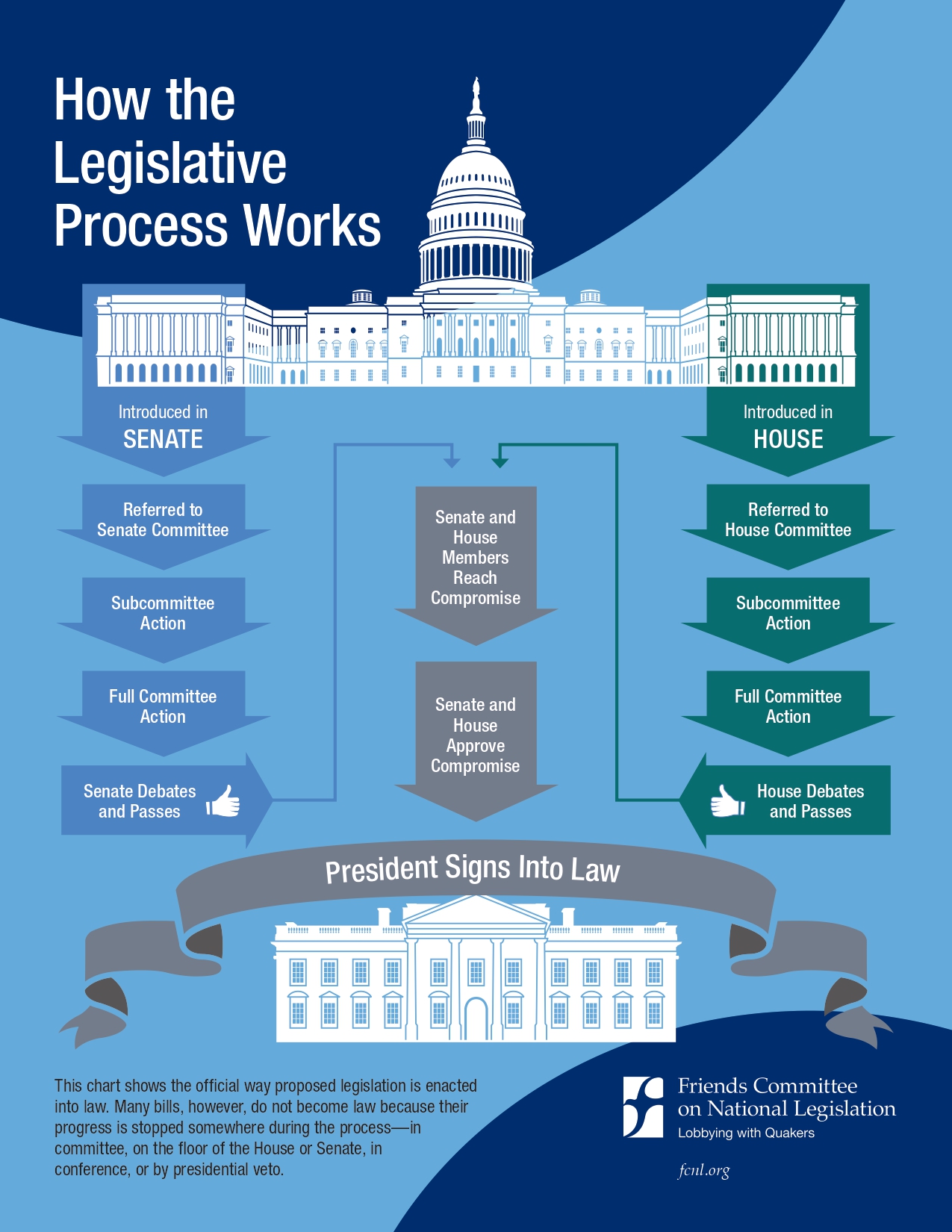
- How European Union Policy is Decided (See Diagram of the Process) (See Video).
- Learn about the U.S. Legislative Process (See Diagram of the Process (PDF)) (See Video).
- Learn about U.S. Executive orders.
- Learn about the Canadian Parliament Process (See Video).
- Learn about the types of legislation and the structure of the Câmara dos Deputados in Brazil.
- Legislative Process in California (See Diagram of the Process).
Who Implements Public Policy?
Those that develop public policies are often not the ones who implement them. For example, a law passed by legislature on a topic related to green chemistry may be implemented by an environmental, public health, occupational health, or agricultural government agency. If it is a national law, implementation could occur at the national level or be delegated to a lower level of government, such as a state, province, or local government. The agency implementing the law needs to follow what is written in the law and might consult their legal counsel for clarity on interpretation, preemption as well as administrative processes. Certain laws are narrow in scope while others give agencies broad authority for voluntary and regulatory efforts that can meet the policy objective.
How can Researchers get Involved in Policy?
While scientists can engage as individual citizens, it is likely more effective to engage through their organization or through a professional society. Researchers can advocate for policies that encourage the adoption of green chemistry and sustainable innovations and solutions. These efforts can provide government officials with a better understanding of available solutions to decisions that have environmental and health consequences. Researchers can achieve impact (PDF) and contribute at various stages of the political and policymaking process. For example, one can:
- Speak with legislators and their staff.
- Submit written or oral testimony on a bill at a select Committee Hearing (example 1, example 2 (49:33)).
- Talk with civil servants who are implementing programs that impact your work or are of interest to you.
- Engage with interest groups, such as trade associations, advocacy groups, professional associations or groups for a specific scientific communities in policy processes such as the Scientists' Coalition for an Effective Plastics Treaty, or the emerging initiative Science Alliance of the Intergovernmental Science-Policy Panel on Chemicals, Waste and Pollution (ISP-CWP).
- Provide substantiative public comments on draft regulation, documents or when input is requested (example of written comments, example of comments from a meeting, example (PDF) of a summary of external peer review and public comments and disposition). Comments could be on behalf of yourself, your department or your organization. If it is from your department or organization, you’ll likely have an internal process for approval and might also have resources for training.
- Participate in working groups or workshops to develop guidance, priorities or reports, for example the OECD workshop on the Design of Sustainable Plastics from a Chemical Perspective which resulted in this report and support materials and the 2024 Federal Sustainable Chemistry Strategic Plan (PDF).
- Apply and become a policy fellow to learn and participate in the policy making process such as those through the American Chemical Society or the American Association for the Advancement of Science.
Learn more on how to become an advocate for policies that advance green and sustainable chemistry.
Use the search form at the bottom of this page to find examples of policies related to chemicals management and sustainability.

Knowledge and Democracy- Why Evidence Matters
How can Educators get Students Involved in Policy?
In addition, one can also engage students in this process. For example, one can:
- incorporate a political advocacy project in an Organic Chemistry course. This open access paper describes a project that was designed to demonstrate that organic, green, and sustainable chemistry can be applied outside of laboratory and industrial settings to help solve issues related to sustainability.
- include a practical science policy exercise that could be included as a companion to learning in the laboratory or classroom. This assignment provides an avenue to address broader applications of science to society while exposing students to meaningful ways to be involved in the democratic process beyond voting.
- have students research pending legislation to support or oppose and prepare talking points or position papers to share with legislators. Students can look for bills in the US using sites like Safer States.
Policy Resources
Explore the resources below to learn more about how science, policy, and sustainability intersect and how you can become an advocate for green chemistry!

ACS Positions on Policy Issues
Interstate Chemicals Clearinghouse (IC2)

ISC3 Policy & Stakeholder Dialogue

Environmental Council of the States
Environmental Council of the States (ECOS) is the national nonprofit, nonpartisan association of state and territorial environmental agency leaders. The purpose of ECOS is to improve the capability of state environmental agencies and their leaders to protect and improve human health and the environment of the United States of America. An example resolution that encourages support for sustainable and green chemistry and the promotion of alternatives assessment is Resolution 17-1: Advancing Safer Chemical Products and Processes.

United Nations Environmental Programme (UNEP)
UNEP promotes green and sustainable chemistry by providing policy guidance, developing tools such as the Green and Sustainable Chemistry Framework Manual, and supporting global efforts to advance safer, more resource-efficient chemical practices that protect human health and the environment. As a member of the Inter-Organization Programme for the Sound Management of Chemicals, UNEP supports the implementation of the Global Framework on Chemicals, for example through the coordination of a global Expert Group on Green and Sustainable Chemistry Innovations and Solutions.

Royal Society of Chemistry
The Royal Society of Chemistry collaborates with partners and performs original research, surveys, events, reports and campaigns to advance the contributions of chemistry in addressing global challenges.

Organization for Economic Co-operation and Development (OECD)
Organization for Economic Co-operation and Development (OECD) is a forum and knowledge hub for data, analysis and best practices in public policy. The OECD works on chemical safety and biosafety, deals with the safe use of chemicals, nanomaterials, pesticides, biocides, and products of modern biotechnology. One area of focus has been on risk management, risk reduction and sustainable chemistry. This effort has resulted in reports, a compilation of resources and webinars.

Change Chemistry Policy Work
Change Chemistry, an organization that aims to make safer and sustainable chemistry widely available in the marketplace, has developed several policy related efforts for their members including idea exchanges and emerging policy updates. They have also collaborated on co-developing resources on European chemical policy initiatives.
Policies
Results are displayed in alphabetical order by title. Use the search bar to refine results. Text searches are full text, not partial word searches. Do you have a policy to add to the list? Click the button. If you are not already logged in, you will be re-directed to login first. All new submissions are automatically directed to site administration for approval to post.
Vermont Act 188 (S.239) - Regulation of Toxic Substances
Act 188 (S.239) requires manufacturers of children’s products to notify the Department
Vermont Bill H.145 - Disbursement Plan; Polychlorinated Biphenyls (PCBs); Remediation; Significant Health Threat
Provides $3 million to the Department of Environmental Conservation for PFAS remediation.
Washington State Industrial Symbiosis Grant Program
Established in 2021, this law set up a competitive industrial symbiosis grant program.
Washington Toxic-Free Cosmetics Act
This law applies to cosmetic products manufactured, distributed, sold, or offered for sale within