Tools & Metrics

Results are displayed in alphabetical order by title. Use the search bar to refine results. Text searches are full text, not partial word searches. Do you have a tool to share with the green chemistry community? Click the button. If you are not already logged in, you will be re-directed to login first. All new submissions are automatically directed to site administration for approval to post.
Displaying 1 - 10 of 67

AI4Green: An Open-Source ELN for Green and Sustainable Chemistry

An Electronic Laboratory Notebook (ELN) combining features, including data archival, collaboration tools, and green and sustainability metrics for organic chemistry. AI4Green is a web-based application, available as open-source code and free to use. It offers the core functionality of an ELN, namely, the ability to store reactions securely and share them among different members of a research team.

Alternatives Assessment Criteria for Hazard Evaluation

The Design for the Environment (DfE) Program at the U.S. Environmental Protection Agency developed the Alternatives Assessment Criteria for Hazard Evaluation as a transparent tool for evaluating and differentiating among chemicals based on their human health and environmental hazards. The Criteria are applied in all of DfE Alternatives Assessments and can be used by other organizations.

To ensure that the Criteria remain relevant and useful for distinguishing among chemicals, DfE may update criteria based on experience conducting alternatives assessments and on stakeholder input.

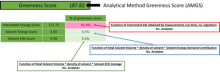
Analytical Method Greenness Score (AMGS) Calculator

Over the last decade, improvements in high-pressure liquid chromatography (from HPLC to UHPLC) and supercritical fluid chromatography (from SFC to UHP-SFC) have led to faster and more efficient separations. However, many of these improvements have yet to be implemented. To encourage analysts to develop greener methods, the Analytical Method Greeness Score (AMGS) calculator provides a straightforward metric to enable the comparison of separation methods used in drug development.

Biocatalysis Guide

The Biocatalysis Guide is a simple double-sided, single-sheet guide to the currently most used enzyme classes amongst the ACS GCI Pharmaceutical Roundtable member companies. It has been produced to be an easy to follow guide for chemists who have not had significant exposure to biocatalysis, showing generic transformations that are available so these can be factored into retrosynthetic analysis. In order to keep the sheet easy to read it is not an exhaustive guide to every transformation and it does not carry literature references.

Biopharma PMI Calculator

The Biopharma Process Mass Intensity (PMI) metric provides a standard method for collecting mass data on the amount of water, raw material, and consumables used to produce 1 kg of biologic drug substance (API). This metric uses common parameters to define biologics manufacturing, which allows for industry-wide bench-marking, increased transparency during process development, and a method to objectively compare processes.

CEPN Worker Survey on Chemical Safety

CEPN’s Worker Survey on Chemical Safety assesses employee awareness, effectiveness of chemical management training and worker engagement. 

The survey captures workers’ perspectives on chemical safety systems in the workplace, supports workplace chemical safety and promotes a culture of worker informed chemical handling.  The survey, available in 12 languages, contains 24 questions on topics such as systems for addressing chemical exposure concerns, how workers might make a suggestion or complaint, and chemical safety training and communication.

Chem21 Solvent Selection Guide

The Chem21 Solvent Selection Guide was produced through an academic-industry consortium in 2016. The consortium surveyed existing solvent guides from various organizations and companies, seeking to elaborate a standard ranking methodology. The methodology is based on easily available physical properties and GHS statements, permitting anyone to establish safety, health, and environment criteria of any solvent, even if full data on the solvents are not yet available. The guide includes classical and less-classical (including bio-derived) solvents.